EduScale
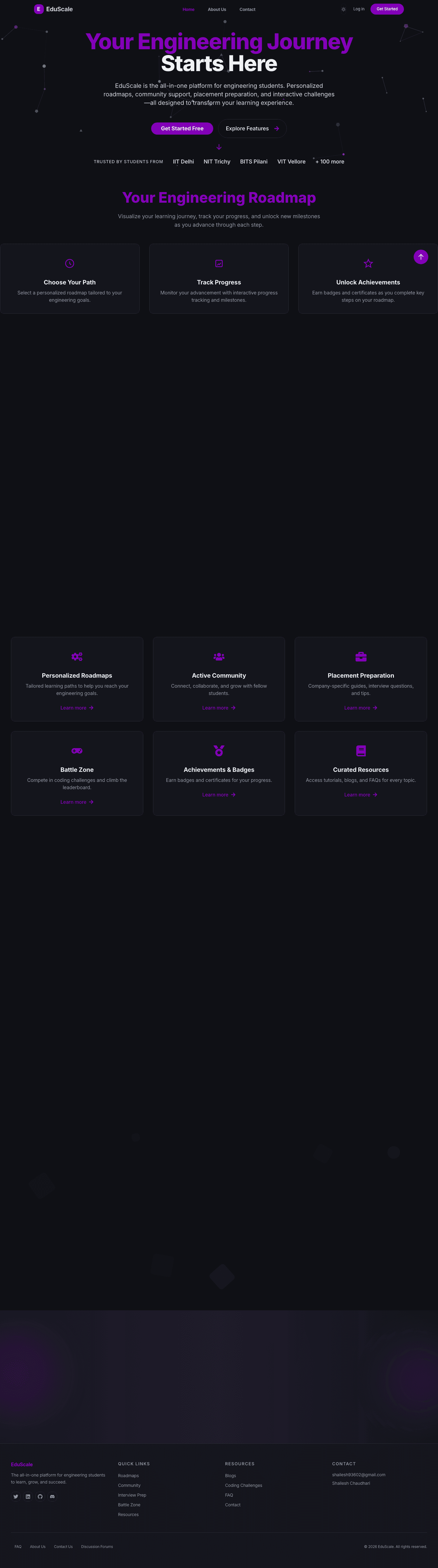
An engineering learning platform with personalized roadmaps, real-time coding battles across multiple Node.js instances, and placement preparation.
Performance & Impact
Redis adapter
Real-time
Cross-instance battle broadcast via @socket.io/redis-adapter (works across Node instances)
Dynamic Elo bands
Matchmaking
Queue expands ±50 rating points every 3 seconds under Redlock mutex, guaranteeing fair peer pairings with zero race conditions
Redlock
Concurrency
Distributed lock on battle queue matching, start, submit-answer, and complete paths so horizontally-scaled instances can't double-write
Circuit breaker
Resilience
opossum around code execution + Redis-backed rate limiting with in-memory fallback
Per-key blast radius
Tenant isolation
Users bring their own LLM key. Model cooldowns and the AI circuit breaker are partitioned per key, so one user's exhausted quota or invalid credential cannot degrade anyone else's — asserted in Backend/src/tests/ai/keyIsolation.test.ts, which drives one user into a rate limit and a second into a bad key and checks neither reaches the other
The Problem
Engineering education is often disjointed, with students moving between static roadmaps, isolated coding editors, and scattered community forums. This lack of integration leads to poor progress tracking and a higher dropout rate during self-paced learning.
The Solution
A unified Engineering Learning Platform (SaaS) that seamlessly integrates structured curriculum with interactive coding tools and real-time social competition. EduScale provides a 'single source of truth' for the student's entire technical journey.
System Architecture
An EdTech platform built around a distributed real-time engine. The backend uses @socket.io/redis-adapter for horizontal Socket.io scaling across multiple Node.js instances, redlock for distributed locking on the battle start / submit-answer / complete paths, opossum as a circuit breaker around the remote code-execution service (Judge0), prom-client exposing a Prometheus /metrics endpoint, and Bull queues for email delivery with a dead-letter queue. Frontend is Next.js 16 App Router with Redux Toolkit. The AI layer (code review, tutor, pgvector-backed recommendations) runs on each user's OWN provider key rather than a shared one — encrypted at rest with AES-256-GCM, with the model-fallback cooldowns and the circuit breaker partitioned per key so one tenant's exhausted quota or bad credential cannot degrade another's.
Core Engineering Achievements:
System Architecture
Frontend
Backend
Infrastructure
"Distributed real-time architecture: Socket.io rooms backed by the Redis adapter for multi-instance scaling. Redlock guards the battle start, answer-submit and battle-complete paths against concurrent writes. An opossum circuit breaker wraps the Judge0 code-execution call. prom-client exposes request-duration, active-connection and memory metrics on /metrics."
Screens
Screenshots from the shipped product.
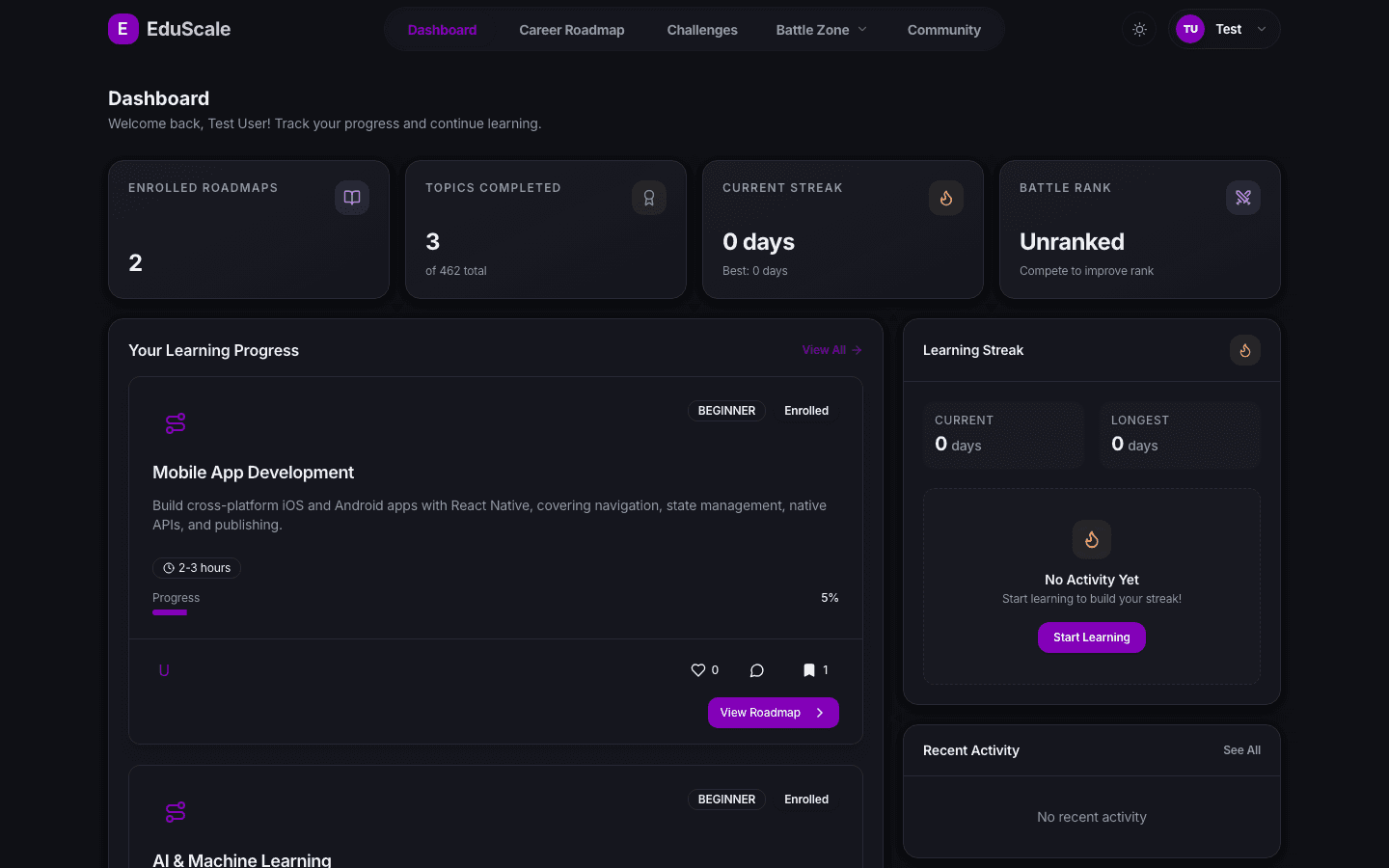
Unified User Dashboard
A centralized hub tracking enrolled roadmaps, ongoing battle states, and overall technical progress. Completely unified between Light and Dark modes.
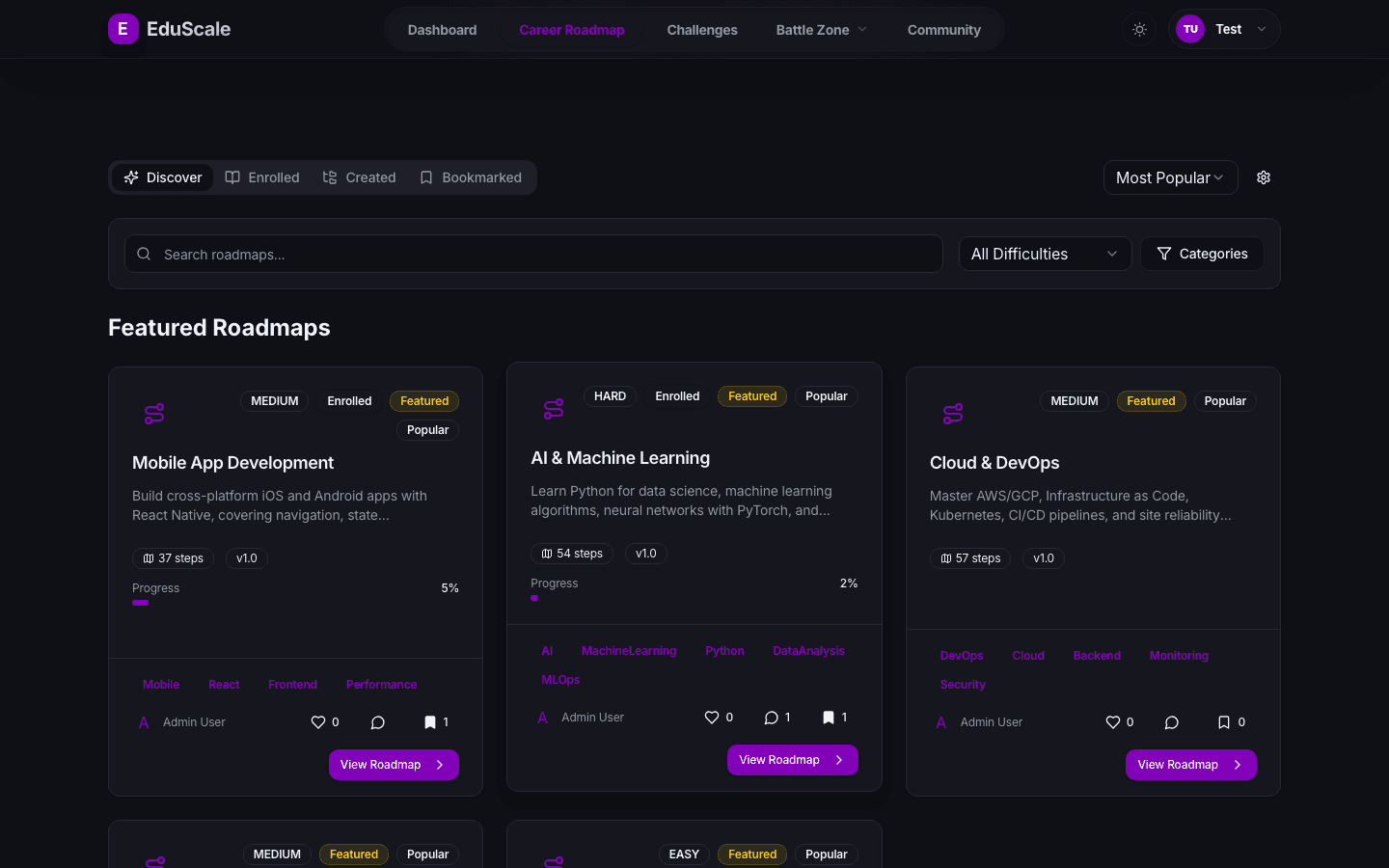
Interactive Career Roadmaps
Node-based curriculum visualization allowing students to track granular progress and unlock specialized technical tracks.
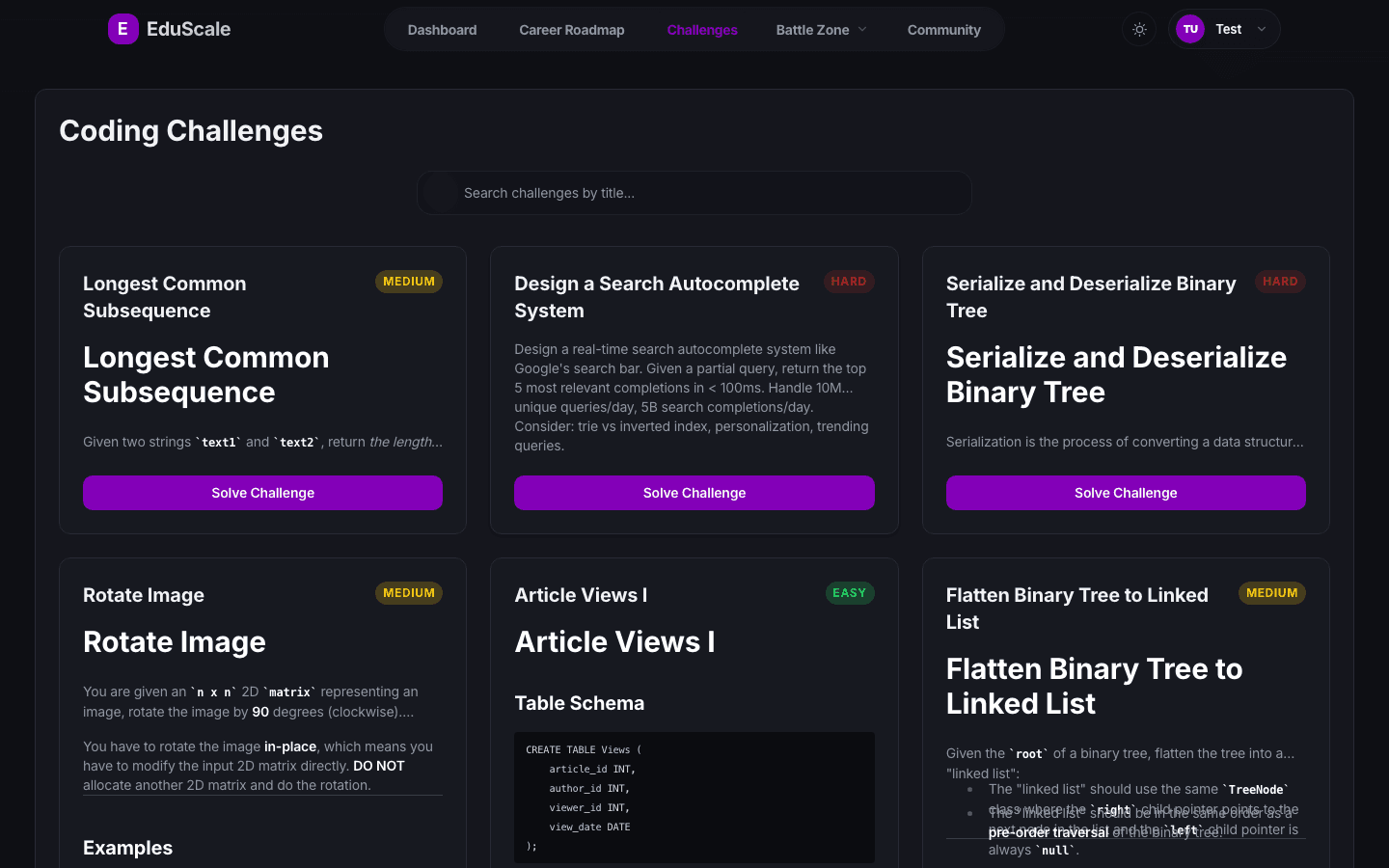
Technical Assessment Suite
A specialized multi-language execution environment providing integrated testing, static analysis, and time complexity benchmarking.
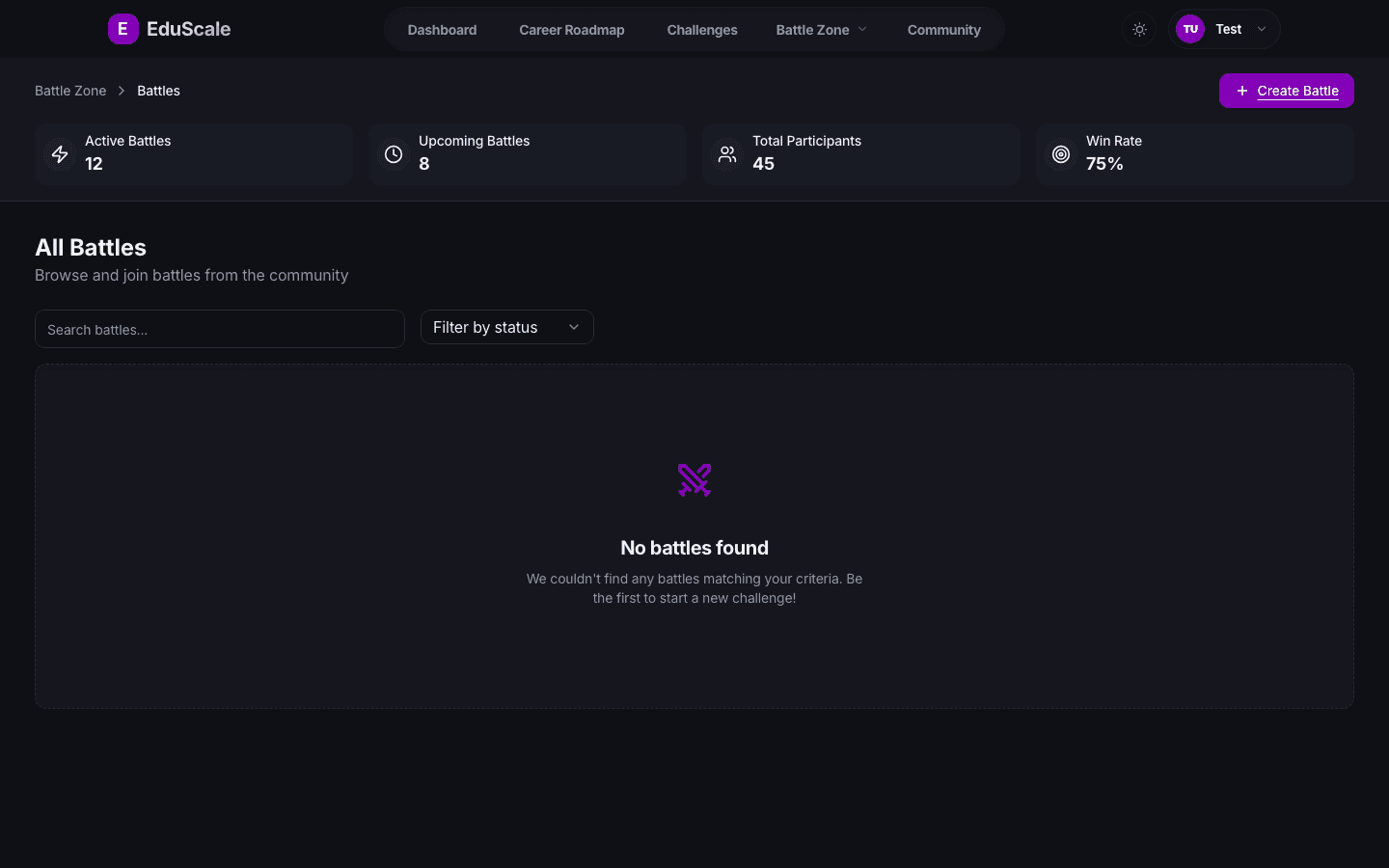
Real-time Battle Zone
A competitive arena powered by WebSockets, allowing real-time multiplayer coding showdowns with live leaderboards.
The Engineering Challenge
The hardest problem was preventing race conditions when two users simultaneously start the same battle or join the matchmaking queue. The fix: redlock acquires a distributed lock (fail-fast, retryCount 0) around the matchmaking pairing, battle start, submit-answer and complete handlers, so two instances can't both claim the same pair or drive the same transition. Socket.io horizontal scaling uses @socket.io/redis-adapter with two independent ioredis connections — pub and sub have to be separate clients or a long-running write on the pub connection stalls the subscriber. opossum wraps the Judge0 code-execution call, with a transport timeout set at or below the breaker's own deadline (Backend/src/utils/deadlines.ts) so a slow executor fails the submission fast instead of leaving the request hanging. The breaker is still a single shared instance behind an unbounded per-user fan-out — FINDINGS.md §13 writes up why that is a design change rather than a timeout, and it is open.
Next.js 16
Framework
PostgreSQL
Engine
High
Complexity
User Journey
Discovery
Users browse high-quality career roadmaps tailored for engineering roles.
Structured Learning
Personalized progress tracking through modules and coding tasks.
Instant Matchmaking
Skill-based queue pairing with dynamic search radar and fair Elo band expansion.
Competitive Practice
Real-time 1v1 or group coding battles to test skills under pressure.
Interview Ready
Mock assessments and AI-driven feedback for placement preparation.
Interested in the full engineering breakdown?
Happy to talk through the technical decisions, from state management strategies to infrastructure scaling.